
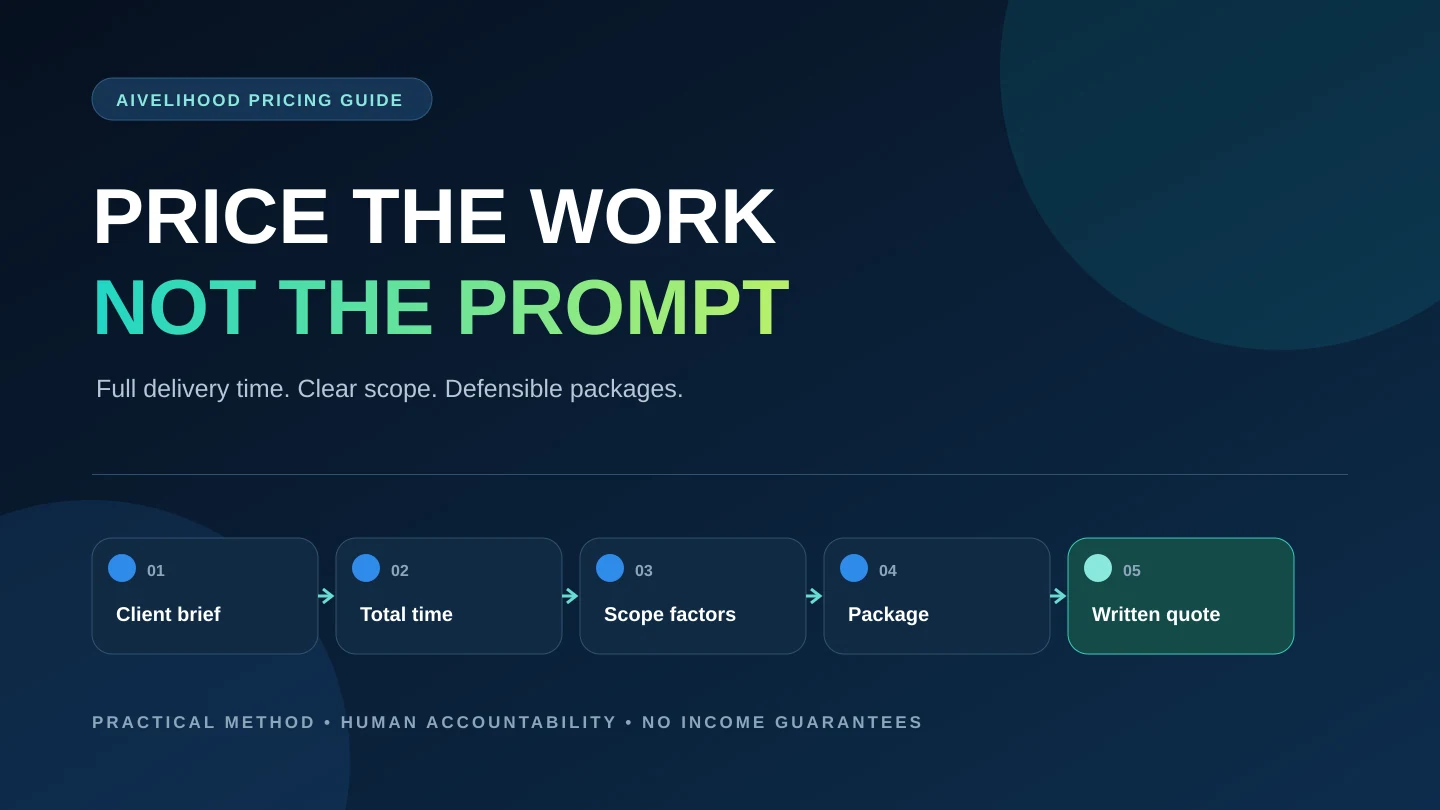
Pricing an AI-assisted service can feel uncomfortable because the visible generation step may take minutes while the useful delivery takes much longer. A client is not buying your prompt speed. They are buying a defined outcome, informed decisions, reliable communication, quality control, revisions, and your responsibility for what is delivered.
There is no universal rate that guarantees a sale. A sustainable quote depends on the deliverables, risk, costs, experience, market channel, and how confidently you can control the result. This guide gives you a method without inventing market averages or promising success.
If you have not selected an offer yet, begin with 15 AI services you can sell without coding. If you still need proof of your ability, create an honest sample with the no-client portfolio guide before asking a buyer to trust a large project.
Price the service, not the prompt
An AI tool may shorten one production step, but a professional delivery contains many steps the client never sees. You must understand the brief, check the source material, decide what the tool should and should not do, review the output, correct errors, format the files, communicate decisions, manage feedback, and deliver on time. Some projects also require research, licensing checks, privacy safeguards, accessibility work, or handoff documentation.
The price therefore should represent the complete scope and the responsibility you accept. If AI reduces routine production time, that efficiency can benefit both sides: the client receives a faster or more consistent workflow, and you retain room to invest in judgment and QA. Charging only for the generation step punishes efficiency and ignores the work that makes the output usable.
A quote still needs an internal cost floor. Estimate all working time, direct project costs, platform or payment fees, taxes and overhead relevant to your business, and a reasonable allowance for uncertainty. That floor tells you whether a proposed price is sustainable. It is not a claim about what every freelancer should charge, and it is not necessarily the final client-facing price.
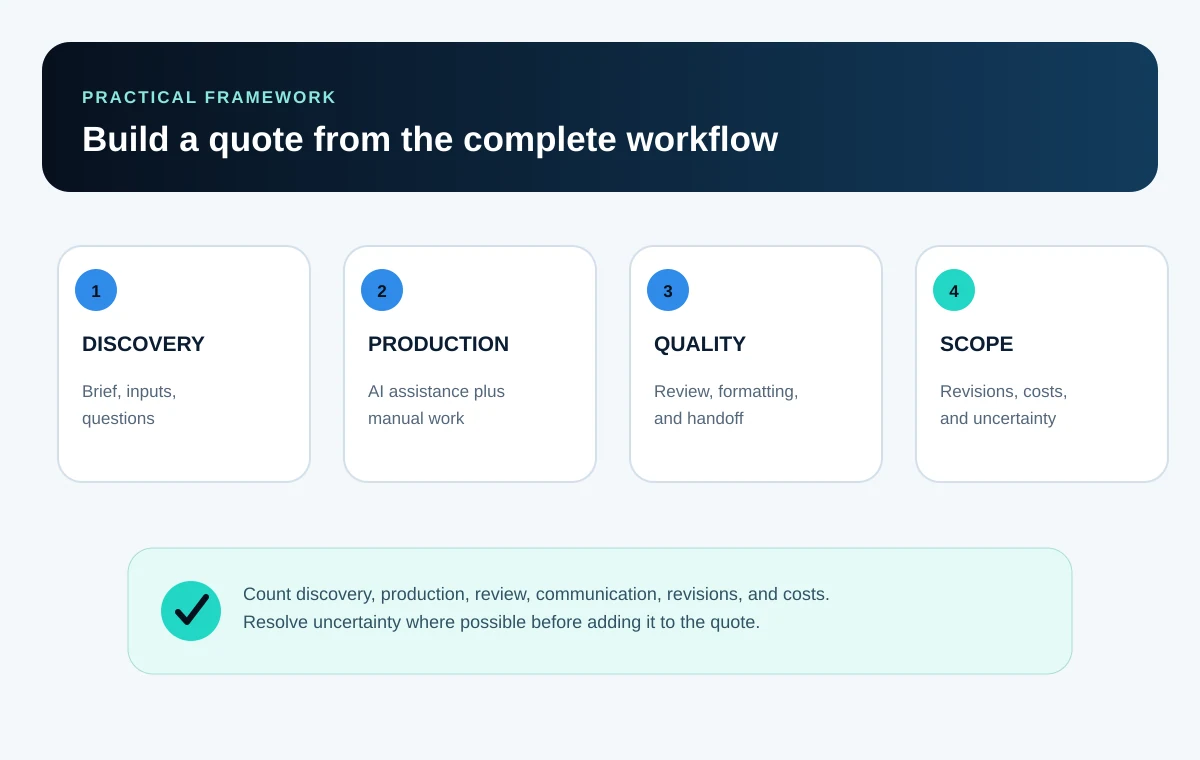
Count the complete delivery workload:
- Discovery, intake, clarification, and proposal preparation.
- Source collection, permissions, research, and file preparation.
- Tool setup, prompting, generation, selection, and iteration.
- Fact-checking, editing, visual inspection, testing, and accessibility review.
- Meetings, written updates, feedback management, and handoff.
- Agreed revisions, export variants, editable source files, and documentation.
- Tool, asset, platform, payment, and other direct project costs.
- A realistic buffer for complexity that you can explain, not a random surcharge.
Seven pricing mistakes beginners can avoid
Copying another freelancer's rate
Their scope, proof, costs, location, client type, demand, and review standard may be completely different from yours.
Pricing only the generated output
A word count, image count, or prompt count ignores discovery, QA, communication, revisions, and accountability.
Offering an undefined revision promise
Unlimited changes can turn a small delivery into an open-ended engagement with no shared finish line.
Discounting before understanding the brief
A low number offered too early can become impossible once formats, stakeholders, source quality, and deadlines are known.
Ignoring fees and direct costs
Platform fees, payment processing, paid assets, transcription minutes, specialist review, and taxes can reduce the amount you keep.
Treating every client as the same risk
A well-prepared brief with one approver is not equivalent to a high-stakes project with missing data and several decision makers.
Using a low price to replace evidence
A clear sample, narrow scope, and reliable process create more trust than a price so low that careful review becomes impossible.
A lower introductory price can be a deliberate choice when your scope is smaller and you are learning the workflow. Make the reduced scope visible. Do not advertise a comprehensive service and quietly remove the review steps needed to deliver it safely.
Choose hourly, project-based, or package pricing
The pricing model should match how predictable the work is. Hourly billing is useful when the scope may change and the client is comfortable approving time. A fixed project fee works when the deliverable, assumptions, and finish line are clear. Packages work when you repeatedly solve the same narrow problem and can standardize the options.
Platforms implement these models differently. Upwork documents hourly and fixed-price contracts, with fixed-price work commonly organized around funded milestones. Fiverr documents packages that can specify inclusions, delivery details, and revisions. Review the current official platform rules before publishing an offer because availability, fees, limits, and protections can change.
| Model | Works best when | Main strength | Main risk | Scope control |
|---|---|---|---|---|
| Hourly | The work is exploratory, ongoing, advisory, or difficult to predict | The quote adapts as approved work expands | The client may focus on hours instead of outcomes; efficiency can reduce billable time | Set an estimated range, weekly limit, reporting method, and approval point for extra time |
| Project-based | The deliverables, inputs, timeline, and acceptance criteria are defined | The client sees one clear price for a result | Underestimating hidden work makes the project unprofitable | Write assumptions, exclusions, revision limits, milestones, and a change-request process |
| Package | You repeatedly deliver a standardized service to a recognizable client type | Buyers can compare scope without a long proposal | Vague tiers can confuse clients or invite the wrong order | Differentiate tiers by meaningful deliverables, depth, turnaround, and support |
A practical decision rule:
- Use hourly pricing when the client is purchasing access to your time and the route to the outcome is uncertain.
- Use project pricing when you can describe what done means and estimate the full delivery effort with reasonable confidence.
- Use packages when the same broad workflow has been completed enough times to make the boundaries repeatable.
- Use milestones for a larger fixed project when the client can review meaningful stages before the next stage begins.
- Use a paid discovery phase when the information needed for a responsible fixed quote does not yet exist.
Estimate the real work before choosing a number
Start by writing the workflow as if another freelancer had to perform it. Estimate each stage separately, using your own sample runs when possible. Do not use the best-case time from a perfect demonstration. Include waiting-independent work such as checking source files, correcting output, naming exports, documenting decisions, and incorporating feedback.
Your private sustainable hourly floor is a planning input, even if the client receives a project price. It can reflect the compensation you need for working time plus your share of business overhead. The exact calculation depends on your circumstances and local tax obligations. Keep it internal unless hourly billing is the chosen model.
A simple project floor is: estimated working hours multiplied by your sustainable hourly floor, plus direct costs, plus an explicit complexity or risk allowance. Then compare that floor with the importance of the outcome, available alternatives, your evidence, and the client's constraints. If the buyer's budget is below the floor, reduce scope or decline; do not silently remove essential QA.
| Work stage | Planning estimate | What to include |
|---|---|---|
| Discovery and setup | 1.0 hour | Brief review, questions, permissions, files, tools, and success criteria |
| Production and iteration | 3.0 hours | Drafting, generation, selection, editing, and client-specific decisions |
| Verification and QA | 2.0 hours | Facts, links, language, formatting, rights, accessibility, and final testing |
| Communication and handoff | 1.0 hour | Updates, delivery notes, exports, source files, and acceptance guidance |
| Revision allowance | 1.5 hours | One consolidated round within the original brief |
| Administration buffer | 0.5 hour | Scheduling, invoicing, archiving, and a modest estimate allowance |
| Estimated work total | 9.0 hours | Multiply by your private sustainable hourly floor, then add direct costs and a justified risk allowance |
Adjust the quote for scope, complexity, and risk
Two projects with the same visible deliverable can require very different effort. A five-page document made from approved copy and a brand template is not equivalent to a five-page document built from scattered notes, disputed claims, and unlicensed images. Ask enough questions to expose the difference before you quote.
Deliverables
List quantities, formats, dimensions, channels, editable files, source documentation, and what the client will receive at each stage.
Revision scope
Define the number of rounds, who consolidates feedback, the response window, and the difference between correcting your error and changing direction.
Complexity
Account for poor inputs, specialist vocabulary, multiple audiences, integrations, data cleanup, accessibility, and the number of decisions required.
Commercial usage
Clarify where and how the work will be used, which files or licenses transfer, and whether broader usage creates additional review or rights work.
Rush delivery
Charge for a compressed schedule only when you can meet it responsibly; consider displaced work, added coordination, and reduced recovery time for problems.
Stakeholders
More reviewers, meetings, approval layers, and contradictory feedback increase communication and revision effort.
Quality and risk
High-consequence claims, sensitive data, brand scrutiny, or specialist review may require more checks, a qualified collaborator, or a decision to decline.
Costs and fees
Include paid assets, tool usage, contractors, platform fees, payment processing, storage, and other project-specific expenses you actually expect.
A revision is a change within the approved brief, such as replacing an example or adjusting tone. A new audience, new source set, additional format, or changed strategy is usually new scope. Put that distinction in the proposal and provide a written estimate before beginning added work.
Commercial usage does not automatically justify an arbitrary multiplier. It is a prompt to understand rights, reach, duration, exclusivity, source-file transfer, and the consequences of failure. Get appropriate professional advice when contracts or intellectual-property questions exceed your competence.
Value matters, but it must be discussed honestly. A client may value an accurate launch asset more than an internal draft because the consequences are different. You can ask what the output supports, what happens if it is late or wrong, and what approval standard applies. Do not invent return-on-investment claims or pretend your work guarantees sales.
Build Starter, Standard, and Premium packages
Three packages should represent three useful levels of scope, not one intentionally weak option and two confusing upgrades. Start with the most common client need as Standard. Remove depth or quantity to create Starter, then add genuinely valuable breadth, support, or complexity for Premium.
Keep quality control at every tier. A Starter package can be smaller, but it should not be less accurate or safe. Differentiate through quantity, research depth, number of channels, turnaround, source files, strategy, or support rather than removing basic review.
For a complete source-to-output example, the AI content repurposing service guide shows how permission checks, source review, channel editing, fact checks, revisions, and handoff create the real workload behind a package.
| Package | Defined input | Core delivery | Review boundary | Best fit |
|---|---|---|---|---|
| Starter | One approved short source asset | Three edited posts for one channel plus a delivery note | One consolidated revision round | A client testing a small, clearly bounded workflow |
| Standard | One approved long-form source asset | Seven edited posts, messaging map, and a simple publishing sequence | Two consolidated revision rounds | A client who needs a complete single-channel campaign |
| Premium | Two approved source assets and a brand brief | Twelve edited posts across two specified channels, content calendar, and handoff guide | Two consolidated rounds plus one scheduled review call | A client coordinating a broader campaign with multiple outputs |
For every package, state:
- Exactly what the client supplies before the delivery clock begins.
- The quantity, format, channel, and editable-file policy for each deliverable.
- What research, strategy, meetings, scheduling, publishing, or implementation is excluded.
- Delivery timing and how delays in client materials or feedback affect it.
- The number and meaning of revision rounds, including the feedback deadline.
- Any optional extras, such as rush delivery or an additional format, with their scope and timing.
Fiverr's official package guidance treats revisions, delivery details, and upgrades as package elements. That is useful as a structure even if you sell elsewhere. Before publishing, use the freelance platform guide and verify the current rules, limits, fees, and protections of the channel you choose.
Communicate the quote so both sides understand it
A strong quote is a short operating agreement, not just a number. Repeat the client's goal in plain language, list the deliverables, identify required inputs, describe the timeline, and state how acceptance and revisions work. Show optional items separately so the client can reduce scope without negotiating away essential quality.
When a buyer asks for a discount, ask which part of the scope should change. You might reduce the number of deliverables, remove a channel, extend the timeline, use one feedback round, or postpone an optional add-on. This keeps the trade-off visible. Avoid unexplained discounts that make future work difficult to price consistently.
A clear proposal can follow this order:
- Objective: the problem and intended use of the finished work.
- Deliverables: quantities, formats, dimensions, files, and completion criteria.
- Inputs and assumptions: what the client provides and what the quote relies on.
- Process: major stages, review points, responsible AI use, and quality checks.
- Schedule: start condition, milestone dates, client feedback windows, and final delivery.
- Revisions: included rounds, feedback method, and examples of new scope.
- Price and payment: the total or rate, milestones, currency, taxes where applicable, and platform terms.
- Exclusions and next step: what is not included and how the client approves the work.
Raise your price from evidence, not impatience
Track estimated versus actual time for every stage, the number and cause of revisions, direct costs, questions that delayed work, and which deliverables clients valued. After several comparable projects, your records will show where the package is under-scoped or where your process has become more capable.
A higher quote can be justified by a clearer specialty, stronger proof, more reliable QA, improved communication, greater demand for limited capacity, broader rights, or a more complex outcome. It should not depend on pretending the AI tool is rare or hiding reduced effort. Efficiency supports margin only when the delivered standard remains strong.
Update future proposals when your evidence supports a change, give repeat clients reasonable notice, and honor accepted agreements. If a current project expands, use the agreed change process rather than retroactively changing its price.
- Compare estimated and actual hours by stage, not only the project total.
- Record direct costs, platform fees, revision time, and unpaid administration.
- Identify recurring client questions that should become intake fields or exclusions.
- Check whether every quality-control step still fits within the price.
- Review current platform policies and fees before updating a listing.
- Keep the old price for an already accepted scope unless both parties agree to a change.
A five-step pricing workflow
Use this sequence before publishing a package or sending a custom quote. The objective is a defensible scope and a sustainable delivery, not a universal perfect number.
- Step 1
Define the outcome and deliverables
Name the client problem, intended use, inputs, quantities, formats, completion criteria, and exclusions. If these are unknown, quote discovery first.
- Step 2
Map and estimate every work stage
Include discovery, preparation, AI-assisted production, human review, communication, revisions, exports, handoff, and administration using your own measured evidence.
- Step 3
Calculate the sustainable floor
Multiply estimated time by your private hourly floor, then add expected direct costs and a justified allowance for complexity or risk.
- Step 4
Check client value and alternatives
Consider the consequence, urgency, usage, proof you provide, and comparable ways the client could solve the problem without inventing ROI or market averages.
- Step 5
Write and confirm the scope
Present the price with assumptions, revisions, schedule, payment, and change rules. Begin only after both sides understand the same delivery.
Use the Start Here path to connect this quote to a complete beginner offer, then follow the 30-day freelance roadmap to test your sample, message, and delivery process without assuming a revenue result.
Final pricing checklist
- The deliverables, formats, quantities, intended use, and acceptance criteria are written.
- All work stages, communication, revisions, direct costs, fees, and handoff time are estimated.
- The selected pricing model matches how predictable the scope is.
- The quote does not rely on an unsupported market average or promised result.
- The included revision rounds and the meaning of new scope are clear.
- Rush work, extra formats, source files, licensing, and commercial usage are addressed where relevant.
- The client knows what inputs and feedback are required and when the schedule begins.
- The price leaves enough time for the human review needed to deliver responsibly.
- Platform fees, payment terms, confidentiality, and current platform rules have been checked.
- Any AI use, data handling, rights, or specialist-review limitations that matter to approval are disclosed.
Official sources to recheck
- Upwork Help - How hourly and fixed-price contracts are different
- Upwork Help - Understanding milestones on fixed-price contracts
- Upwork Resource Center - How to estimate fixed-price projects
- Fiverr Help Center - What are packages?
- Fiverr Help Center - Managing Gig extras, source files, and shipping
- U.S. Small Business Administration - Break-even point guidance
Frequently asked questions
Should I charge hourly or per project for AI freelance work?
Use hourly pricing when the work is exploratory, ongoing, or difficult to predict. Use a project fee when the deliverables, assumptions, timeline, and acceptance criteria are clear. Packages are useful after a narrow workflow becomes repeatable. The best model is the one that makes the remaining uncertainty visible and manageable.
Should AI make my freelance service cheaper?
Not automatically. AI may reduce time in one step, but your quote still covers discovery, judgment, source preparation, quality control, communication, revisions, tools, and responsibility for the result. Efficiency can improve your margin or turnaround without removing the need for a sustainable price.
How do I set a price when I have no clients yet?
Run a complete concept project, measure each work stage, calculate a private cost floor, and keep the first paid scope narrow. Build a clearly labeled sample rather than inventing client experience. Your first price is a reasoned starting point that should be reviewed against real delivery data, not a guarantee of demand.
How many revisions should I include?
Include the number you can estimate and support for the service, often as one or more consolidated rounds rather than unlimited individual changes. Define a revision as a change within the approved brief. A new audience, strategy, source set, format, or deliverable should trigger a new estimate.
How should I price rush delivery?
First confirm that the deadline allows responsible work. Estimate the displaced capacity, extra coordination, schedule risk, and any added costs. Present rush delivery as an optional scoped add-on with a clear start condition. Decline it if the compressed timeline would undermine verification or quality.
Should I charge extra for commercial usage or source files?
Address them explicitly because broader usage, exclusivity, editable files, or asset licensing can change the work and rights involved. There is no universal multiplier. Describe what transfers, what remains licensed, and any added preparation. Seek qualified advice when the rights question exceeds your competence.
What if the client says my quote is too high?
Ask about the priority and budget, then offer a smaller legitimate scope: fewer deliverables, one channel, a longer schedule, or fewer feedback rounds. Do not quietly remove essential QA. If the client's required outcome cannot be delivered sustainably within the budget, decline respectfully.
How do I account for platform fees?
Check the current fee shown by the platform for the specific proposal, offer, or contract, because policies can change and fees may vary. Include expected fees in your internal net-income calculation while following platform rules. Do not rely on an old percentage copied from another freelancer.
When is it reasonable to raise my price?
Review prices when measured delivery time, costs, demand, specialization, proof, scope, or quality requirements change. Update new quotes and give repeat clients reasonable notice. Honor accepted agreements, and use a written change request if an active project's scope expands.