
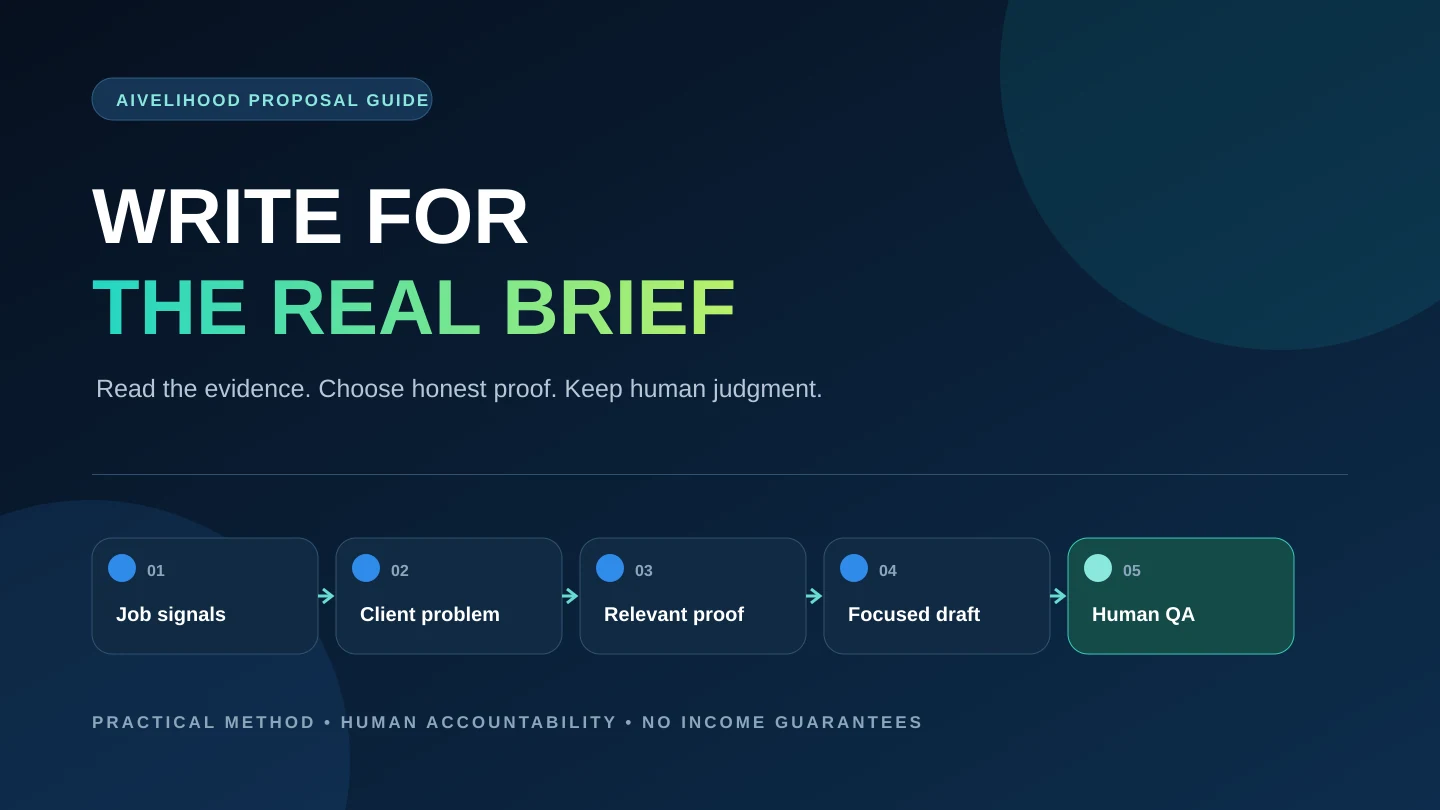
A generic proposal can lose relevance before the client reaches your credentials. It talks about the freelancer, repeats broad promises, and leaves the buyer to work out whether the applicant understood the assignment. Adding AI can make that problem worse: a polished draft may still be interchangeable with many other applications.
Use AI as an analyst and editor, not as a substitute for reading the job post or deciding what you can honestly deliver. Your job is to identify the client's likely problem, choose evidence that supports your fit, make the important decisions yourself, and remove anything the tool invented or over-polished.
This guide is for freelancers who know roughly what they offer and want a repeatable proposal process. If your offer is still unclear, use the Start Here path, then compare 15 AI services you can sell without coding. If you are choosing a marketplace, compare Fiverr and Upwork for beginners before writing platform-specific applications.
A proposal is a response to evidence, not a biography
The strongest raw material is already in the job post: the requested outcome, deliverables, constraints, examples, questions, and language the client uses to describe the problem. A proposal should respond to those signals. Your profile can hold your broader background; the proposal should explain why a small, relevant part of that background helps with this job.
Generic proposals reverse that order. They open with enthusiasm, list tools, summarize a career, and mention the work near the end. AI readily produces this pattern when the prompt lacks evidence and constraints.
Upwork's current proposal flow may ask for contract terms, a cover letter, screening answers, and work samples or attachments, depending on the post. The number of Connects required is shown for a proposal and can vary. Check the live form and official guidance before submitting because platform fields and policies can change. The framework below is AIvelihood's editorial recommendation for thinking through those fields; it is not an Upwork rule or a promise that a client will respond.
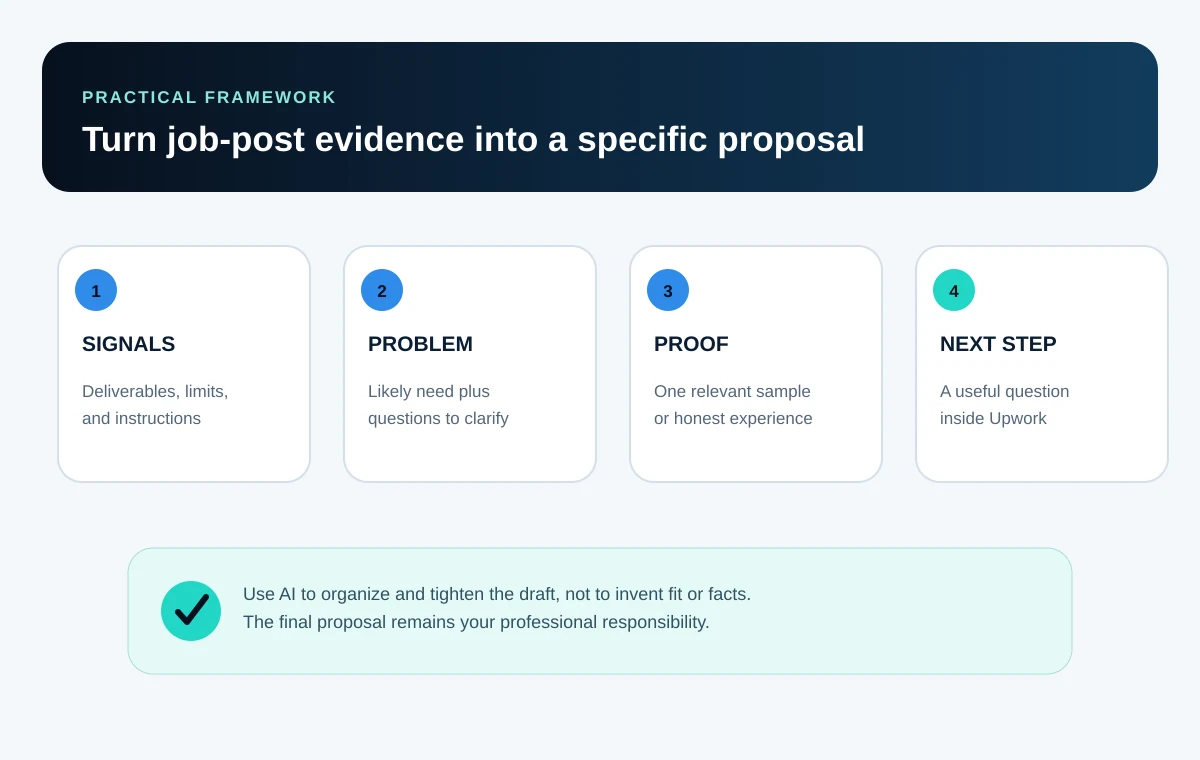
A useful proposal lets the client answer four questions quickly:
- Did this freelancer understand the work I described?
- Can they point to relevant evidence without exaggerating it?
- Is their proposed next step practical for this project?
- Can I trust the details in this application enough to continue the conversation?
Read the job post as a set of decision signals
Do not ask AI to write until you have extracted the brief. Read the post once for the overall request, then a second time to mark concrete evidence. Separate what the client explicitly said from what you infer. An inference can guide a question; it should not become a fact in the proposal.
Copy only what the analysis needs, and remove names, contact details, confidential material, and sensitive files before using an external AI tool. An NDA or confidentiality clause does not by itself answer whether you may send the material to a third-party AI service. Check the agreement, client instructions, and the tool's data controls; when permission is unclear, keep the material out of the tool.
| Signal in the post | What it may indicate | What to verify or address |
|---|---|---|
| Named deliverables and formats | The client has a defined handoff in mind | Confirm quantity, format, source files, intended use, and acceptance criteria |
| A deadline or launch date | Timing may be a real constraint | State availability honestly and ask what inputs or approvals control the schedule |
| Examples of tone or style | Consistency may matter more than novelty | Reference the requirement and explain one relevant process or sample |
| A long list of tools | The workflow or compatibility may matter | Mention only tools you can actually use and ask which are required versus preferred |
| Previous freelancer problems | The client may be protecting against a repeat failure | Address the named failure with a specific QA step, without criticizing an unknown person |
| A vague objective with few details | Discovery may be needed before a fixed scope | Ask one or two high-value questions instead of pretending the scope is already clear |
Client problem
What is blocked, inconsistent, missing, risky, or taking too much attention? Quote or paraphrase evidence from the post rather than guessing a private motive.
Desired outcome
What should exist or be easier after delivery? Distinguish the deliverable from a business result you cannot promise.
Relevant skills
Which one or two abilities are essential for this outcome? A complete tool inventory is rarely useful.
Hidden concern
What uncertainty might the client need resolved, such as accuracy, voice, turnaround, rights, or handoff? Treat this as a hypothesis to test, not a fact.
Proof
Which sample, process detail, credential, or prior responsibility can you substantiate and connect directly to the request?
Next step
What small question, sample review, or scope confirmation would make the conversation more useful for both sides?
Decide what AI should help with - and what remains yours
AI is most useful when it transforms material you selected: organizing the brief, exposing gaps, comparing a draft with requirements, suggesting shorter phrasing, or testing whether a sentence sounds vague. It is least trustworthy when asked to supply missing evidence, decide whether you are qualified, infer a client's private priorities, or promise an outcome.
Upwork offers AI features, including Uma, and provides AI preference controls. Features can change, so review current guidance and account settings. With any tool, you remain responsible for the application's truthfulness and professionalism.
| AI can assist with | The freelancer must decide and verify |
|---|---|
| Extract stated deliverables, constraints, questions, and terminology | Whether the extraction is complete and whether the job is a genuine fit |
| Turn the brief into a checklist or a set of clarification questions | Which question matters enough to ask and what assumption is unsafe |
| Offer several opening drafts based on supplied evidence | Which opening is accurate, natural, and appropriate to send |
| Compare portfolio descriptions with the job requirements | Whether the sample is truly relevant and whether you have permission to share it |
| Find repetition, vague claims, long sentences, or robotic phrasing | The final voice, meaning, scope, availability, price, and professional commitment |
| Flag unsupported names, numbers, credentials, results, and tool claims | Remove or correct every unsupported detail and manually submit the final proposal |
A seven-step AI-assisted proposal workflow
- Step 1
Capture evidence
Record the stated problem, outcome, deliverables, constraints, required questions, and exact terms that affect the work. Keep facts separate from your interpretations.
- Step 2
Make a fit decision
Check whether you can deliver the core work, meet the timing, follow the communication rules, and show relevant proof. Skip jobs that require you to misrepresent your ability.
- Step 3
Choose one proof point
Select the closest honest sample, responsibility, or process. Write one sentence explaining its relevance instead of attaching an unexplained collection.
- Step 4
Draft from structured inputs
Give AI the redacted evidence, your verified proof, your proposed approach, and strict instructions not to add facts. Ask for alternatives, not a final application.
- Step 5
Rewrite the opening and core
Choose the strongest accurate idea, rewrite it in your own voice, answer screening questions separately, and remove biography that does not support the brief.
- Step 6
Run a risk and brevity check
Verify every claim, link, name, file, term, price, and availability statement. Cut duplication, generic praise, unnecessary tools, and accidental confidential details.
- Step 7
Preview and submit manually
Read the final application in the actual form, confirm the current Connects requirement and terms, then submit only when the proposal still matches what you can deliver.
A structured prompt can make Step 4 more reliable. Supply labeled sections such as JOB EVIDENCE, MY VERIFIED PROOF, PROPOSED APPROACH, OPEN QUESTIONS, and DO NOT CLAIM. Ask the tool to identify missing information before drafting. Then request two or three concise options that use only the supplied evidence.
Do not send the first result. Read it against the post, then make sure the final wording reflects your understanding, availability, boundaries, and ability to follow through.
Write the opening two or three sentences around the job
The opening does not need to perform a personality. It needs to show that you noticed the work. Start with a concrete part of the brief, connect it to the outcome or risk, and state the most relevant next action or proof. Avoid repeating the job title, praising the posting, or announcing that you are the perfect candidate.
The example below is an illustrative scenario, not a real client or a claim about proposal performance. Imagine a fictional post asking a freelancer to turn two founder interviews into one 1,200-word article and five social posts while preserving the founder's voice.
| Version | Illustrative opening | What the client learns |
|---|---|---|
| Generic | Hello, I am excited to apply. I am a highly skilled content writer who uses the latest AI tools to create engaging content, and I am confident I can exceed your expectations. | Very little: the same paragraph could be sent to almost any writing job, and every claim still needs evidence. |
| More specific | You already have the source material; the difficult part is turning two conversations into one coherent article without flattening the founder's voice. I would first map the recurring ideas and approved quotes, then build the article and five posts from the same source map so the message stays consistent. | The writer identified the transformation, named a relevant risk, and proposed a process connected to the requested deliverables. |
A reliable opening pattern:
- Sentence 1: name the important problem, constraint, or tradeoff visible in the post.
- Sentence 2: describe the first relevant action or decision you would take.
- Sentence 3, if useful: connect one verified sample or ask one question that affects the approach.
Personalization means responding to job-specific evidence, not searching for private facts or praising the company. Show how a stated audience, deadline, source format, failure condition, or handoff changes your approach.
If the post contains too little evidence for a specific opening, say what you understand and ask a focused question. A careful question is more credible than a detailed plan built on assumptions.
Connect portfolio evidence instead of dropping a link
A portfolio link becomes useful when you explain what the client should inspect. Choose the closest sample, state whether it is client work or a clearly labeled concept project, and point to the relevant decision or deliverable. Do not imply that a fictional sample came from a paying client, and do not share work you lack permission to disclose.
For the illustrative interview-to-content brief, a useful evidence sentence might be: 'This clearly labeled concept case study shows how I turned one source transcript into an article outline and three channel-specific excerpts; the source-mapping and voice-review sections are the closest match to your brief.' Replace that description with your real sample and its actual contents.
If you have no relevant client history, build truthful proof before competing on unsupported claims. The guide to building an AI portfolio without clients shows how to label concept work and document the process. Once you understand the effort behind the sample, use the AI freelance pricing method to set terms without letting a language model invent a market rate.
Before attaching or linking a sample, confirm:
- You have the right to share the work and any underlying assets or client information.
- The sample is close enough to the requested task to help the client evaluate fit.
- The label accurately distinguishes client work, self-initiated work, and an illustrative concept project.
- Your description names the relevant process or deliverable instead of claiming an unsupported business result.
- The link works without requiring unexpected access and the file contains no private comments or hidden data.
Shorten an overlong draft and remove robotic language
An AI draft often says the same thing several times in different forms: enthusiasm, capability, commitment, and a promise of quality. Cutting these lines does not make the proposal cold. It makes room for details the client can evaluate.
The following before-and-after is an illustrative editing example. It does not represent a real applicant, job, or outcome.
| Draft | Illustrative text | Edit decision |
|---|---|---|
| Before | With my extensive passion for content creation and deep commitment to delivering exceptional results, I believe I would be an ideal fit for this exciting opportunity. I use advanced AI-powered tools to streamline workflows while ensuring the highest level of quality and attention to detail for every client. | Remove unsupported superlatives, generic enthusiasm, a vague tool claim, and a statement that could apply to any project. |
| After | I would map the two interview transcripts into themes and approved quotes before drafting. That source map would guide both the article and the five posts, followed by a manual voice and attribution check before delivery. | Replace self-description with a relevant process and a check tied to the fictional brief. |
Search the draft for language that sounds polished but carries no evidence:
- Claims such as perfect fit, exceptional quality, guaranteed satisfaction, or exceed expectations.
- Openings such as I am thrilled to apply when no useful detail follows immediately.
- Tool inventories that do not affect the proposed delivery.
- Repeated versions of I understand your needs without saying what those needs are.
- Corporate transitions such as furthermore, moreover, and in conclusion used only to connect short ideas.
- Long closings that repeat availability, enthusiasm, and confidence instead of proposing one practical next step.
Ask AI to flag sentences that could fit an unrelated job and explain why. Keep context that prevents misunderstanding, especially details about scope, risk, accessibility, privacy, or specialist review.
Read the proposal aloud once. If a sentence contains words you would not use in a short professional conversation, rewrite it. Natural language is not deliberately casual or imperfect; it is precise language that sounds like the same person the client will meet after hiring.
Common proposal mistakes and hallucination risks
Letting AI fill missing facts
A plausible detail is still false. Names, tools, experience, metrics, availability, and project assumptions must come from the post or your verified records.
Writing before deciding fit
A polished proposal cannot fix missing ability, an impossible deadline, a prohibited request, or a scope you cannot evaluate responsibly.
Restating the entire job post
Briefly show understanding, then add a relevant decision, proof point, question, or process. Paraphrasing alone creates no value.
Over-personalizing
Using unrelated personal information, guessed motives, or excessive praise can feel intrusive. Personalize around the work the client chose to publish.
Attaching everything
A large unsorted portfolio makes the buyer find the evidence. Select one or two relevant items and explain the connection.
Ignoring screening questions
Answer each requested question accurately and directly. Do not hide a missing answer inside a general cover letter.
Promising outcomes outside your control
You can commit to a process, deliverables, checks, and communication. You cannot guarantee hiring, traffic, sales, rankings, or client approval.
Moving communication unsafely
Follow Upwork's current rules for contact information and pre-contract communication. Do not put private contact details into a proposal because a template suggested it.
Hallucinations are not limited to dramatic fabrications. A draft may subtly change two interviews into three, turn preferred software into a strict requirement, call a concept sample client work, or promise a delivery date you never approved. Compare every noun, number, proper name, credential, link, and commitment with the source evidence.
Authenticity also applies after the proposal. Upwork's official guidance emphasizes accurate representation and professional communication. Maintain the same voice and capabilities in messages and interviews; do not send a sophisticated AI-written application and then pretend to understand decisions you did not make.
Use AI without exposing the client or misrepresenting yourself
Before prompting, classify the material as public, sensitive, personal, confidential, or covered by an agreement. Share the minimum, remove identifying data, and check current tool controls. If permission is unclear, use redacted notes or analyze it manually.
This guide does not impose a universal AI-disclosure sentence. Obligations may depend on platform rules, client instructions, the work, local law, and agreements. Answer process questions honestly, and disclose AI use when it materially affects approval, confidentiality, rights, safety, or the expected method.
Do not use AI to impersonate another freelancer, fabricate identity or qualifications, or generate confidential examples. Upwork provides separate guidance on authentic representation, professional communication, contact-information safety, AI preferences, and non-disclosure agreements. Review the current official pages linked below when those issues apply; this article is educational guidance, not legal advice.
A safer minimum-input practice:
- Remove the client's name, email, contact details, private URLs, and unrelated background.
- Summarize the relevant public requirements instead of uploading the entire post or attachment.
- Do not upload work samples, interview transcripts, or documents unless you have the right and a valid reason to do so.
- Tell the model to use only supplied evidence and to mark unknowns as questions.
- Review generated text locally against your notes before putting it into the platform form.
- Keep your final proposal and evidence notes so you can support every statement in a later conversation.
Final proposal quality-control checklist
Run this check after drafting, not while you are still trying to decide whether the job fits. A short proposal with verified details is safer than a longer one that mixes facts, assumptions, and generated claims.
- The opening responds to a real detail in the job post rather than generic enthusiasm.
- The client problem and desired outcome are grounded in stated evidence; inferences remain questions or hypotheses.
- Every claim about experience, clients, results, tools, credentials, availability, and location is accurate and supportable.
- The proposal identifies one relevant proof point and explains why it matters to this work.
- The proposed approach fits the deliverables, deadline, source material, and constraints actually described.
- Screening questions are answered directly, and required terms or attachments are complete.
- No confidential material, personal data, private contact information, hidden file metadata, or restricted work has been exposed.
- The draft does not promise hiring, approval, revenue, traffic, rankings, or another outcome outside your control.
- Generic praise, repeated biography, irrelevant tools, unsupported superlatives, and robotic transitions have been removed.
- Names, numbers, links, filenames, pricing, availability, and delivery commitments have been checked against the sources.
- The closing proposes one useful next step without pressure or a repeated sales pitch.
- You reviewed the live Upwork form, current Connects requirement, platform rules, and final preview before manually submitting.
Official sources to recheck
- Upwork Help - How to submit a proposal on Upwork
- Upwork Help - Understanding and using Connects
- Upwork Resource Center - How to create a proposal that wins jobs
- Upwork Resource Center - Cover letter tips
- Upwork Help - How to use Uma as a freelancer
- Upwork Help - How to control your AI preferences
- Upwork Help - How to represent yourself authentically
- Upwork Help - How to communicate professionally
- Upwork Help - How to keep your contact information safe
- Upwork Help - How non-disclosure agreements work on Upwork
Practice the process on one suitable job post
Choose one current post that genuinely matches your narrow service. Do not begin by writing. Complete the evidence table, make a fit decision, choose one honest proof point, and draft three different openings from the same facts. Keep the version that makes the client's task easiest to understand, then run the final checklist.
If your service, sample, and terms are not ready, pause the application and strengthen those foundations. The practical AI freelancing roadmap connects service selection, proof, pricing, and client communication. For a paced implementation sequence, use the 30-day roadmap rather than trying to automate every proposal at once.
Track the process, not a promised response rate: Did you choose suitable work, use real evidence, and make claims you could defend in an interview? Those decisions remain yours even when the hiring outcome does not.
Frequently asked questions
Can I use AI to write an Upwork proposal?
AI can assist with organizing a job post, finding gaps, drafting alternatives, shortening text, and checking relevance. You remain responsible for every claim, commitment, file, and message. Review current Upwork rules, client instructions, confidentiality terms, and the AI tool's data controls before use.
Do I have to disclose AI use in every proposal?
This guide does not claim there is one universal disclosure rule for every AI-assisted proposal. Requirements can depend on the platform, client instructions, type of work, local law, and agreements. Answer honestly when asked, and disclose when AI use materially affects approval, confidentiality, rights, safety, or the expected method.
How long should an Upwork proposal be?
Use the shortest length that clearly addresses the job, connects relevant proof, answers required questions, and proposes a practical next step. There is no useful universal word count for every brief. Remove biography and tool lists that do not help the client evaluate this work.
What should the first sentence of my proposal say?
Respond to a concrete problem, constraint, deliverable, or tradeoff in the post. For example, identify the important transformation or risk and state the first relevant action you would take. Do not invent private details or open with unsupported claims about being the perfect fit.
What if I do not have a matching client sample?
Use the closest work you have and explain the limits of the comparison, or create a clearly labeled concept project that demonstrates the relevant process. Never present fictional work as a paid client engagement. If no sample supports the core skill, build proof before making a strong experience claim.
Should I include questions in the proposal?
Ask one or two questions when the answers affect scope, method, timing, rights, or quality. A focused question can show judgment. Avoid a long discovery questionnaire before the client has decided whether to continue, and do not ask for information already stated in the post.
How do I stop AI from inventing experience?
Provide a closed list of facts it may use, explicitly prohibit new claims, ask it to mark missing evidence as a question, and then verify every noun, number, name, credential, result, and link. A prompt reduces risk; it does not replace human review.
Should I use the same proposal template for every job?
Reuse a review process, not a finished message. A stable checklist can prevent omissions, but the opening, proof, questions, and approach should respond to the actual brief. Skip jobs where you cannot create that connection honestly.
Does a better proposal guarantee that I will be hired?
No. Client decisions depend on factors you cannot fully observe or control. This workflow is meant to improve relevance, accuracy, and professional communication; it does not guarantee views, replies, interviews, contracts, income, or any other outcome.