
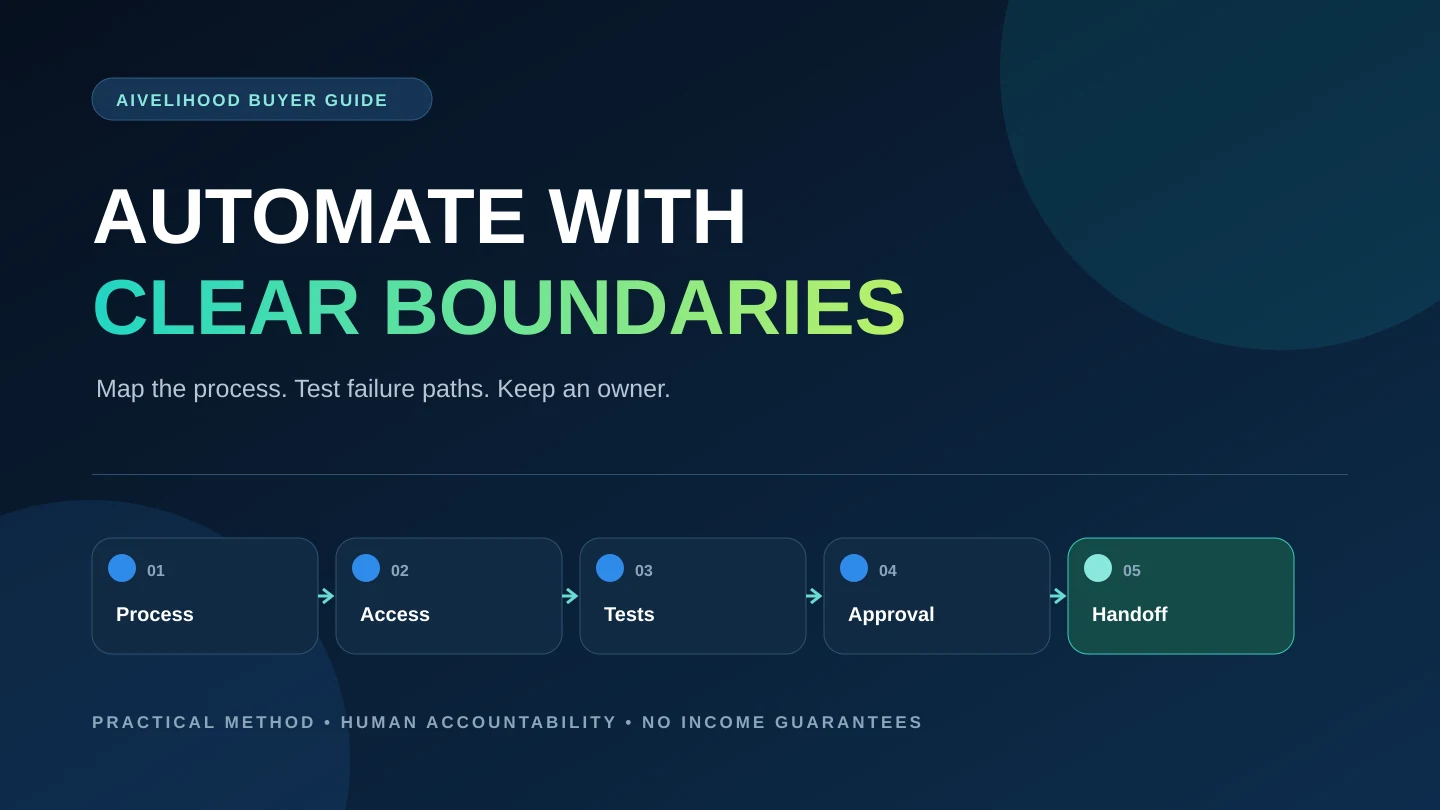
An automation that drafts an internal summary has a different risk profile from one that sends customer emails or updates invoices. Before hiring anyone, write down what the workflow may read, what it may change, and who must approve the result. Those decisions matter more than a promise to build an 'AI agent.'
This guide is for a small business with a repeatable process and a person available to review it. It explains how to buy a bounded automation pilot, not how to build one. For standalone content or design deliverables, start with the general AI freelancer hiring checklist.
Choose a process that is stable enough to automate
Describe the manual workflow before selecting software: what starts it, where the input lives, how a person decides what to do, and what counts as done. If the process changes every week or nobody agrees on the result, document and simplify it first. Software can repeat confusion as easily as it repeats useful work.
Use ordinary rules for predictable conditions. AI may help interpret unstructured text or draft material that a person reviews; it need not make every routing decision. Ask candidates which steps should use fixed rules, which may use AI, and which should stay manual. A proposal that removes unnecessary AI can be a better fit than a more elaborate one.
| Use case | Possible AI contribution | First pilot boundary | Reason to delay |
|---|---|---|---|
| Internal meeting notes | Draft a summary and suggested tasks | Human approves every task; no automatic assignment | Participants have not agreed to how recordings or notes are handled |
| Incoming inquiry triage | Suggest a category from message text | Write suggestions to a test queue; no customer reply | Messages contain sensitive information with no handling policy |
| Content repurposing queue | Draft channel-specific text from an approved source | Human edits and approves; publishing remains manual | Source rights or factual review responsibility are unclear |
| Weekly operational summary | Explain already validated structured figures | Read-only inputs and a draft report | Nobody can reconcile the underlying numbers |
These are illustrative scoping ideas, not claims that a particular product or seller supports them. Avoid beginning with autonomous payments, account deletion, unrestricted customer messages, or professional advice. If a mistake could cause material harm, obtain qualified review and narrower permissions before considering deployment.
Turn the workflow into a testable pilot brief
List allowed input types and what should happen when a required field is missing. Define who reviews uncertainty and how the process resumes after a failure. Avoid a brief that merely says 'connect my apps' or specifies a tool without a business outcome.
Separate discovery, implementation, acceptance, and ongoing support in the quote. An unfamiliar system or undocumented integration may require paid discovery before a responsible freelancer can estimate the build. Do not treat an uncertain estimate as a fixed commitment to unlimited troubleshooting.
Include these decisions in the written scope
- Trigger, input systems, permitted data, expected output, and actions explicitly excluded.
- The human approval step and a way to stop or bypass the workflow.
- A representative test set, expected results, and conditions that block launch.
- Who owns accounts, workflow files, prompts, configuration, and documentation.
- Build fee, subscriptions, usage-based costs, support period, and future change pricing.
- What counts as a bug in the agreed scope versus a new feature or a changed external service.
Evaluate the specialist beyond a successful demo
Look for a freelancer who can explain a workflow similar in risk and complexity to yours. Familiarity with your actual systems matters more than a long list of automation tools. Ask for a permitted demonstration or redacted case study showing the freelancer's role, not another client's confidential credentials or production access.
Have the candidate walk through one ordinary input and one failure. Ask how they prevent duplicate actions when a request is retried, where errors appear, who receives an alert, and how a staff member can recover. A screen recording of the happy path alone leaves those questions unanswered.
| Criterion | Useful evidence | Unresolved concern |
|---|---|---|
| Process understanding | A diagram with explicit inputs, outputs, and approval points | Tool names with no explanation of your workflow |
| Failure handling | A duplicate-input or unavailable-service demonstration | Only the successful path is shown |
| Access discipline | A list of minimum permissions for each connection | Requests for shared passwords or unrestricted administrator access |
| Maintenance | Editable delivery, runbook, and clear support boundaries | Only the seller can operate or change the system |
| Cost clarity | Separate build, subscription, usage, and support assumptions | A fixed savings promise with no workload assumptions |
If you cannot judge the answers, keep the pilot read-only or use an independent technical reviewer. Do not invent your own expertise to approve a system you cannot safely operate. For marketplace context, consult how Fiverr and Upwork organize freelance work; neither model removes the need for technical evaluation.
Agree account ownership and access before connecting anything
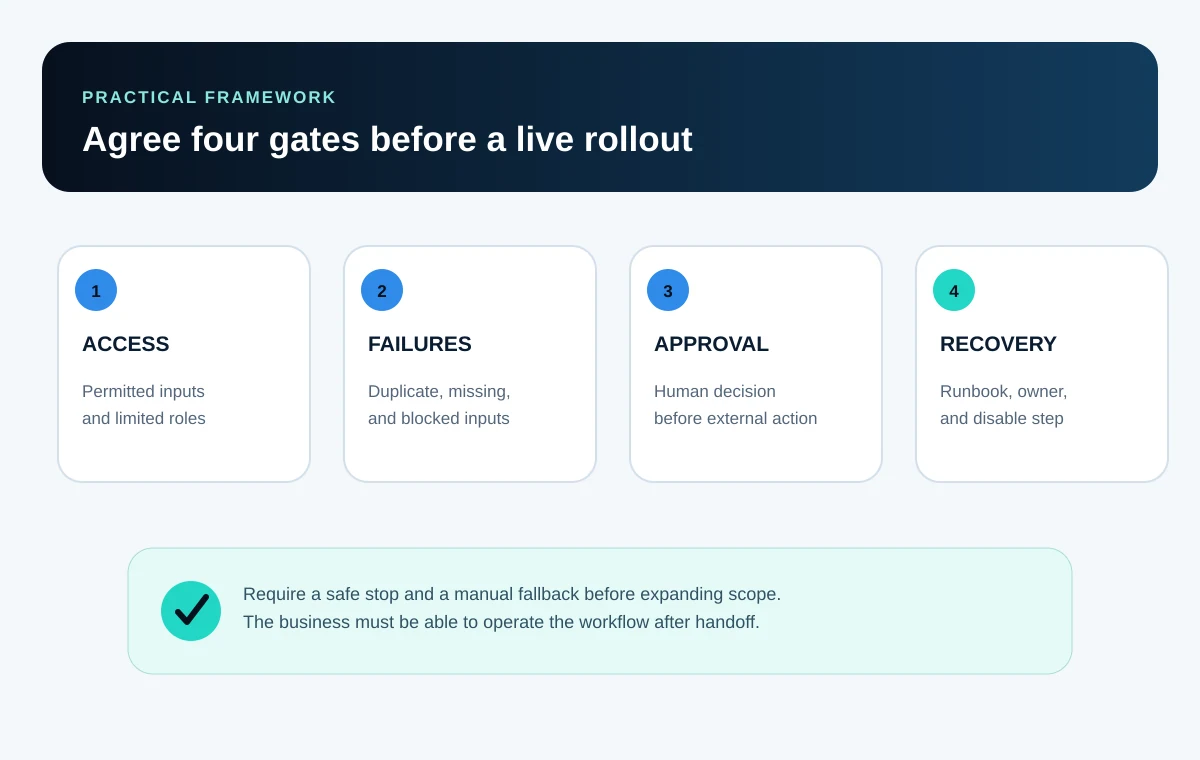
As an editorial starting point, the business should control its accounts and billing. Give a freelancer a separate, limited invitation where the service supports it, and remove temporary access after handoff. Ask for an access list explaining why each permission is needed. You should approve a permission because of a defined task, not because broad access is convenient.
Keep API secrets and passwords out of shared briefs, screenshots, public repositories, and front-end code. Agree how secret values will be stored and who can revoke them. Begin with sanitized data and a test workspace where possible; moving to live data should be a separate decision after review.
For an AI step, document which provider receives the data, what the inputs contain, and which retention and training settings apply. Check those settings against the business's obligations before allowing uploads. A generic confidentiality promise does not answer where the workflow sends information.
Make acceptance tests part of the delivery
Build a small test set with expected behavior before implementation. Include normal, incomplete, duplicate, and out-of-scope inputs. Agree what errors must be corrected before launch and which ambiguous cases must be routed to a person. The goal is observable behavior, not an unsupported accuracy percentage.
- Normal input produces the agreed draft output in the right destination.
- Missing or unsupported input is flagged, not silently invented or discarded.
- Repeating the same trigger does not create an unintended duplicate action.
- A disconnected service or usage limit produces a visible error and a recovery step.
- Untrusted text cannot change the workflow's permitted actions or reveal protected instructions and data.
- The approval gate prevents external sending, publishing, or updates until a person authorizes them.
- The owner can disable the automation and complete the task manually.
Request a record of the inputs, expected behavior, actual behavior, and unresolved issues. Successful sample tests do not prove reliability at every future volume or for every new input. Start with a limited rollout, inspect outputs, and expand only after the owner can support the process.
Compare total cost and handoff, not just the build fee
Ask for a cost worksheet with four separate lines: setup, recurring software, usage-based charges, and support or changes. Record the assumed workload and check how retries or longer inputs affect it. Do not ask for a universal monthly figure before the workflow and software plans are known.
Compare that estimate with the current manual process using your own observations of staff time, review effort, and error correction. Savings are uncertain until you operate the workflow. A technically working automation may still be a poor purchase if usage is rare or review costs remain high.
Require an editable workflow or export where the chosen system supports it, an account and dependency inventory, a runbook, a stop procedure, and agreed support boundaries. Clarify who pays for and performs repairs after a tool changes. For a content workflow, our repurposing tool comparison and delivery workflow guide explain why human editing remains part of the cost.
Choose a hiring route once the pilot is clear
Fiverr is one place to compare freelance offers for a bounded project. A trusted specialist, a referral, another marketplace, or a retained technical team may fit better when requirements span several systems or ongoing support is essential. If the process is still unstable, a manual checklist can be the better immediate choice.
If you can describe the pilot and its acceptance tests, compare Fiverr freelancers for your automation brief. This is a Fiverr Marketplace affiliate link; AIvelihood may earn a commission from a qualifying transaction. It does not endorse a particular seller or guarantee a working integration. Read the Affiliate Disclosure.
Send the same brief to suitable candidates, compare their questions and assumptions, and resolve access and maintenance terms before ordering. Your next useful artifact is a one-page pilot brief, not a subscription to every tool mentioned in a proposal.
Sources and limits of this guidance
Reviewed September 12, 2026. The pilot and acceptance framework is AIvelihood editorial guidance, not a hands-on review of a seller or automation platform. Fiverr's official AI guidance and terms provide platform context. Confirm current seller scope and service-specific permissions, costs, and terms before buying; this article makes no claims about a particular tool's availability or performance.
Official sources to recheck
Frequently asked questions
Do I need AI, or will a simple automation do?
If fixed rules can produce the required result, start by evaluating that approach. AI is a candidate for interpreting unstructured inputs or drafting material for review, but it adds uncertainty and an additional data-handling decision. Ask the specialist to justify each AI step.
Can I hire a freelancer without sharing my password?
Ask whether each system supports a separate invitation, a restricted role, or a limited integration credential. You should retain account ownership and a way to revoke access. If the available access is broader than the job requires, pause and agree a safer scope before proceeding.
Is maintenance included in the one-time price?
Only if the agreed offer says so. Ask what the support period covers, who handles external-service changes, how new features are quoted, and what happens when that period ends. Do not assume an editable workflow includes indefinite support.