
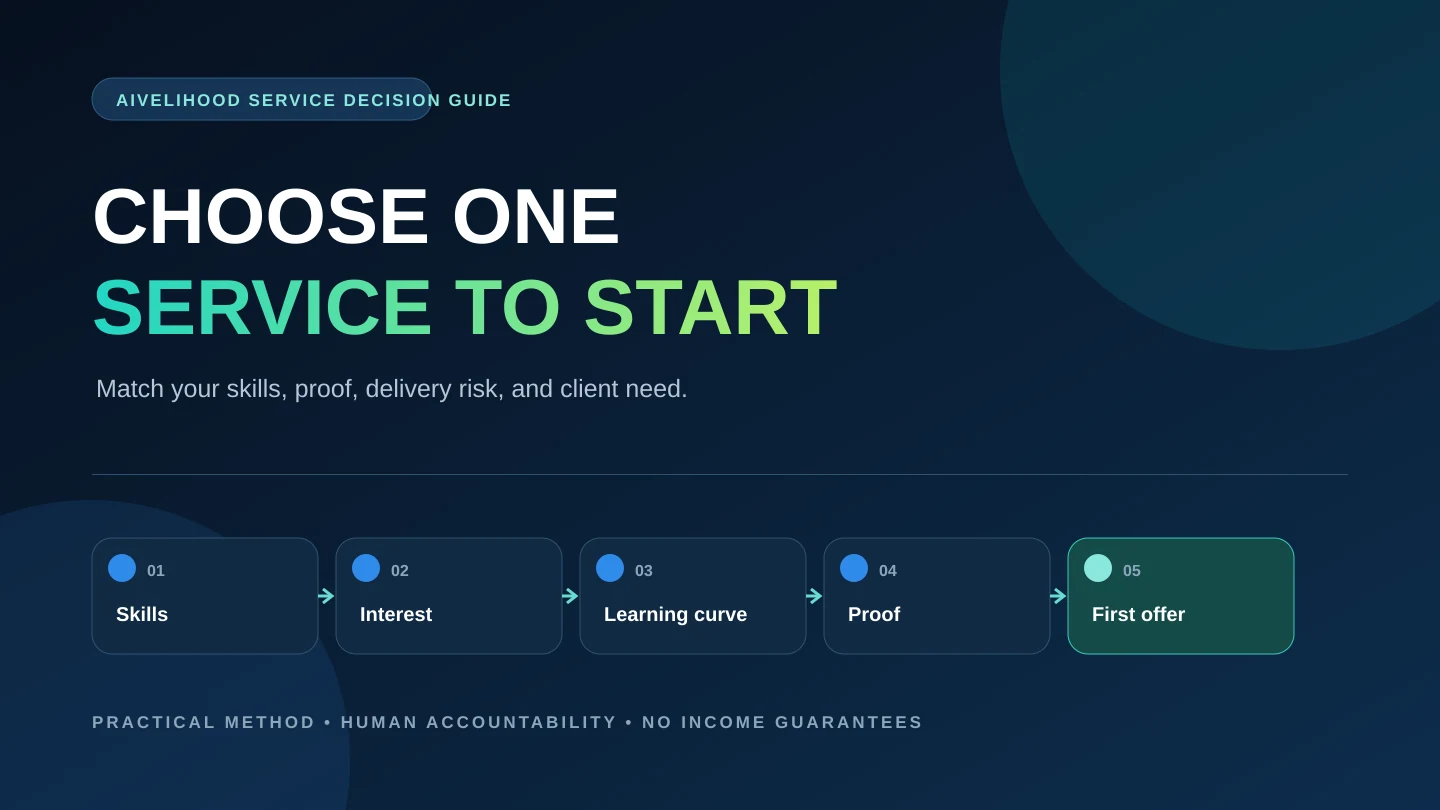
The wrong first service is often not a bad idea. It is an offer with too many unknowns at once: a new skill, an unfamiliar tool, an unclear deliverable, no credible sample, and client consequences you cannot yet judge. That combination makes practice slow and paid delivery risky.
Your first choice does not need to identify the most profitable service or predict permanent demand. It needs to give you a manageable way to build skill, produce visible proof, explain an outcome, and learn from a small market test. Treat the choice as a focused experiment rather than a lifelong identity.
If you need ideas before making the decision, review 15 AI services you can sell without coding. This guide helps you reduce those possibilities to one. The broader AI freelancing roadmap then connects that choice to a portfolio, pricing, client communication, and responsible delivery.
Choose one learning loop, not ten disconnected services
Trying ten services at once creates ten briefs, ten tool stacks, ten quality checklists, and ten ways to misunderstand scope. You may stay busy making profiles and watching tutorials without completing one sample that a client can evaluate.
One narrow service creates a shorter loop: study a real problem, make one deliverable, inspect the result, explain the process, gather feedback, and repeat. What you learn can later support adjacent offers, but the first loop should be small enough to finish.
Upwork's current freelancer-profile guidance advises emphasizing primary talents instead of presenting every skill, while its Project Catalog guidance asks freelancers to consider work they have done, work they enjoy, services that package into defined deliverables, and samples they can show. These are platform-specific references, not evidence that one service guarantees sales. The decision framework below is AIvelihood's editorial guidance for applying similar practical questions before you publish anywhere.
A first service is ready for serious practice when you can:
- Name one client problem without describing the AI tool as the product.
- Define a visible deliverable, format, quantity, and completion point.
- Create a representative concept sample using material you own or may legally use.
- Review the output with your own skill instead of trusting generation alone.
- Explain the main limitations, inputs, revisions, and client responsibilities.
- Decline projects whose risk exceeds your current competence.
Inventory what you can already do without AI
Start with evidence from ordinary work, study, hobbies, volunteering, or personal projects. AI can accelerate a workflow, but it cannot give you reliable judgment in a field you cannot evaluate. A fluent writer can catch tone and logic problems. A careful spreadsheet user can detect broken totals. Someone who understands a process can tell when an automation skipped an exception.
Write down tasks you can complete, not personality labels such as creative, organized, or technical. For each task, add the standard you use to decide whether it is correct. That second column exposes whether you have a review skill or only an interest in the output.
Skills
What can you draft, edit, design, research, organize, calculate, document, or troubleshoot now? Include languages, industries, and software you genuinely understand.
Evidence
What files, projects, coursework, volunteer work, or personal outputs demonstrate that ability without exposing confidential information?
Review judgment
Which errors can you reliably detect: factual, grammatical, visual, numerical, procedural, accessibility, privacy, or rights-related?
Interest
Which type of work can you repeat through revision? Interest matters most after the novelty of an AI tool disappears.
Constraints
How much uninterrupted time, client contact, software cost, language fluency, and device access can you realistically support?
Risk boundary
Which work should you not accept because errors could materially affect health, legal rights, money, safety, identity, employment, or protected data?
A useful inventory statement is concrete: 'I can edit clear English, compare a draft with a source, and build a structured Google Doc, but I cannot verify medical claims or design a brand identity.' That is more actionable than 'I am good at ChatGPT.'
Match your strengths to six service categories
Categories are starting points, not promises about demand. The same client project may combine several of them. For a first offer, choose the category where you can define the output and catch mistakes with the least guesswork.
| Category | A reasonable fit when you can | Possible first deliverable | Main review burden |
|---|---|---|---|
| Writing | Edit for meaning, tone, structure, and factual support in the delivery language | Three revised product descriptions from an approved source sheet | Accuracy, unsupported claims, originality, voice, and client-specific details |
| Design | Judge hierarchy, spacing, contrast, consistency, export formats, and asset rights | Five social graphics from an approved copy and visual brief | Readability, cropping, licensing, brand consistency, accessibility, and AI artifacts |
| Research | Find primary sources, compare like with like, cite evidence, and show uncertainty | A five-source research brief with links, dates, criteria, and unresolved questions | Source quality, currency, citation accuracy, bias, and false certainty |
| Automation | Understand the manual process, permissions, conditions, failure paths, and handoff | A tested form-to-spreadsheet workflow using fictional data | Privacy, duplicate actions, failed runs, access control, monitoring, and changing integrations |
| Content repurposing | Preserve meaning while adapting approved source material for different formats | One article outline and five social posts from a client-approved transcript | Context, quotation accuracy, permissions, channel fit, and factual consistency |
| Admin and productivity | Organize files, data, schedules, notes, or procedures and verify every transformation | A cleaned synthetic spreadsheet with a data dictionary and change log | Silent data loss, confidentiality, formula errors, version control, and unclear ownership |
Who may prefer each category:
- Choose writing when you already edit language with care and can verify the subject matter from supplied or public sources.
- Choose design when you can explain visual decisions and inspect the final export, not merely select an attractive template.
- Choose research when you enjoy tracing claims to evidence and are comfortable recording uncertainty instead of filling gaps.
- Choose automation when you can map a stable manual process and test failures with low-risk data; it is not the safest first choice if permissions and error handling are unfamiliar.
- Choose content repurposing when you can preserve source meaning and adapt it rather than producing disconnected summaries.
- Choose admin or productivity work when accuracy, documentation, and repeatability are stronger skills than persuasion or visual style.
If design or presentation work passes your readiness checks, the Canva portfolio workflow shows how to organize an honestly labeled sample, visible decisions, quality checks, and a tested public or PDF delivery.
If content repurposing passes the same checks, use the source-to-deliverable repurposing workflow to define permissions, channel briefs, quality control, revisions, and a small portfolio sample before offering it to clients.
Move through the service-selection framework in order
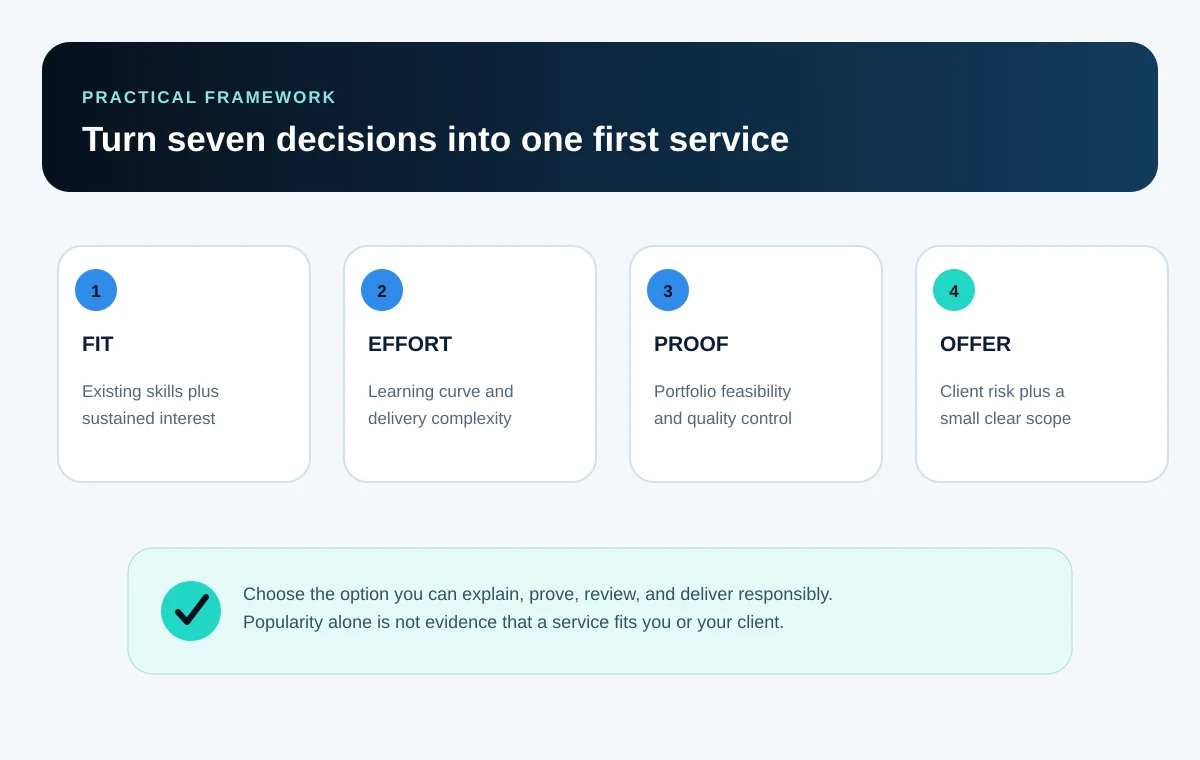
- Step 1
Skills
Keep candidates that use at least one ability you can already demonstrate and one review standard you understand.
- Step 2
Interest
Ask whether you can repeat the underlying task through feedback and revision, not whether the tool demo feels exciting.
- Step 3
Learning curve
Identify the missing skills, rules, tools, and domain knowledge. Separate a learnable workflow gap from a professional-judgment gap.
- Step 4
Deliverable clarity
Write the format, quantity, inputs, exclusions, revision boundary, and completion standard in plain language.
- Step 5
Portfolio feasibility
Confirm that you can create a representative concept sample legally, label it honestly, and show the decisions a buyer needs to inspect.
- Step 6
Client risk
List what can go wrong, who could be affected, how errors are caught, and which jobs remain outside your competence.
- Step 7
First offer
Package the smallest useful outcome you can deliver consistently instead of advertising a broad role or unlimited AI capability.
Compare three candidates with the same decision questions
Shortlist three services, then score the same criteria from 0 to 2: 0 means the evidence is missing, 1 means it is partly ready, and 2 means you can explain and demonstrate it. The total is a discussion aid, not a prediction of demand or income. A serious risk can veto a candidate even when its total is high.
| Criterion | 0: not ready | 1: partly ready | 2: ready to test |
|---|---|---|---|
| Existing skill | The core task is new | Related skill, limited practice | Relevant work and review judgment exist |
| Learning curve | Major domain and tool gaps | One manageable gap | Can complete a supervised practice workflow now |
| Delivery complexity | Many tools, permissions, approvals, or failure paths are unresolved | The main workflow works, but handoffs or edge cases remain unclear | Small, reversible steps have a documented handoff and fallback |
| Deliverable clarity | Outcome is broad or subjective | Output is named but boundaries are vague | Format, inputs, exclusions, and acceptance check are clear |
| Portfolio feasibility | Cannot create legal, representative proof | Can show part of the workflow | Can build and explain one honest end-to-end concept project |
| Client communication | Requires discovery you cannot lead | Needs several unresolved decisions | Can collect inputs with a short, specific brief |
| Quality control | Cannot reliably detect important errors | Can review some failure points | Has a repeatable checklist for the critical risks |
| Delivery risk | Errors may cause serious harm or irreversible loss | Moderate consequences need stronger controls | Small, reversible delivery with clear limits |
| Beginner suitability | Depends on judgment, credentials, or security controls you do not have | Low-risk practice is possible, but paid scope needs supervision or narrowing | Can be practiced end to end, checked independently, and scoped safely |
Add one sentence under every score. 'Portfolio feasibility: 2 because I can use my own webinar recording and show the corrected transcript, source map, and final posts' is useful. A bare number is easy to inflate.
Then apply three veto questions: Does the service require a credential you do not hold? Could normal errors materially harm a person's rights, health, finances, safety, identity, or employment? Would delivery require client data that you cannot handle securely? A yes does not mean the field is permanently closed; it means this version is not an appropriate first offer.
Beginner suitability describes your present readiness for one defined scope; it is not a universal label attached to an entire service category. After the readiness gates pass, look for demand evidence in several current briefs or client conversations: a recurring problem, recognizable inputs, clear constraints, and a buyer who needs the outcome. One viral post or one marketplace listing cannot establish future sales. If you cannot find plausible evidence of a buyer and problem, keep the candidate as a practice project rather than publishing a sales claim.
See how the same framework leads to different choices
The scenarios below are illustrative examples, not real clients, earnings claims, or evidence that a category will sell. Their purpose is to show how existing ability and risk change the decision.
Illustrative scenario: the careful bilingual editor
Mina writes and edits fluently in two languages but has no design experience. A narrow localization review for low-risk marketing copy fits better than logo generation. She can build a side-by-side concept sample, explain terminology decisions, and decline certified or high-stakes documents.
Illustrative scenario: the operations coordinator
Leo has years of spreadsheet cleanup and procedure documentation but little interest in promotional writing. A synthetic-data cleanup sample or a tested SOP is more credible than a social-content offer. He can show row reconciliation, a change log, and exception handling.
Illustrative scenario: the video hobbyist
Sam can edit owned footage, correct captions, and judge pacing. A small clip-and-caption package is feasible if rights and context are controlled. AI voice cloning is a poor first offer because consent, identity, and misuse risks exceed the current process.
Notice that none of the choices begins with 'Which AI tool is popular?' The tool comes after the problem, deliverable, proof, and review capability. A tool may change or disappear; the client still needs the output to be accurate and usable.
Avoid first offers with hidden complexity or high consequences
A service can look simple because AI produces a draft quickly. Delivery complexity includes everything after that draft: source rights, fact checks, client approvals, revisions, formatting, accessibility, privacy, security, integrations, and responsibility for errors.
Usually poor first offers unless you already have the required expertise and controls:
- Legal, medical, financial, hiring, credit, insurance, or safety-critical advice and decisions.
- Voice, face, avatar, or identity replication without explicit rights, consent, and misuse safeguards.
- Unattended automations that send messages, move money, change records, publish content, or touch production systems.
- Unlimited content packages whose quality, originality, and source verification you cannot maintain.
- Translation into a language you cannot fluently review, especially for contracts, health, safety, or regulated material.
- Research that promises certainty from unverifiable sources or requires access to confidential, personal, or restricted data.
- A broad 'AI consultant' offer without a defined problem, deliverable, implementation boundary, or evidence of relevant judgment.
Popularity is not a substitute for fit. A crowded category may still suit you if you have relevant proof and a clear niche. A new category may still be a poor choice if you cannot review its output. Use current platform categories and client briefs as research inputs, not as instructions to copy the most visible listing.
Fiverr's current AI guidance states that AI-assisted work should be customized, meaningfully refined, and supported by the freelancer's own skill and effort. It also emphasizes rights, privacy, and accountability for the final work. Review the live policy and the rules of any other platform or tool before offering a service because requirements can change.
Run a seven-day validation exercise before publishing
- Day 1
Shortlist three services
Use your skills inventory and choose candidates with visible deliverables. Write why each is plausible and what would disqualify it.
- Day 2
Study real briefs and rules
Review current marketplace categories, public job briefs, platform policies, and tool terms. Record recurring inputs and risks without copying another seller's work.
- Day 3
Score the candidates
Complete the decision table with evidence sentences and risk vetoes. Select one candidate for a concept project.
- Day 4
Write a fictional brief
Define a believable but clearly fictional client situation, owned or licensed inputs, deliverables, exclusions, timeline, and acceptance checks.
- Day 5
Complete the workflow
Produce the sample from intake through delivery. Track manual time, decisions, corrections, tool costs, and points where information was missing.
- Day 6
Review and explain the proof
Run the quality checklist, ask a relevant reviewer for process-focused feedback if available, and turn the work into an honestly labeled case study.
- Day 7
Define the first offer
Specify one outcome, audience, input set, deliverable, boundary, revision rule, and next test. Reject or narrow the service if the sample exposed unsafe gaps.
Validation does not mean proving that strangers will buy within seven days. It means replacing assumptions with evidence about your ability to complete, review, explain, and scope the work. After that, a small marketplace listing, relevant proposal, or direct conversation can test client interest without pretending the outcome is guaranteed.
Present the concept project honestly. The portfolio guide for beginners without clients shows how to label a fictional brief and document the problem, process, decisions, quality checks, and final deliverable.
Turn the winning candidate into the smallest useful offer
Do not advertise 'AI writing,' 'AI design,' or 'automation' alone. Those labels describe methods or categories. A client needs to know what will be delivered, what they must provide, what is excluded, and how quality will be checked.
| Broad category | Narrow illustrative first offer | Why it is easier to evaluate |
|---|---|---|
| AI content | Turn one approved 20-minute interview transcript into a source-linked article outline and five reviewed social-post drafts | The source, quantity, formats, and review task are visible |
| AI design | Create five correctly sized event graphics from approved copy, brand assets, and a supplied style guide | Inputs, asset rights, export sizes, and consistency checks can be specified |
| AI research | Build a five-source feature comparison using current official product pages, capture dates, criteria, and uncertainty notes | The evidence standard and limits are part of the delivery |
| AI productivity | Clean a supplied spreadsheet using an agreed schema and deliver the cleaned file, validation summary, and change log | Transformations can be audited and totals can be reconciled |
Once the scope is real, estimate the full work rather than the seconds spent generating a draft. The AI freelance pricing framework covers discovery, production, review, communication, revisions, usage, and risk without relying on a fabricated market average.
Correct the mistakes that make a first offer fragile
- Choosing a tool instead of a client outcome. Fix it by naming the deliverable and the decision it supports.
- Copying a popular offer without matching skills. Fix it by requiring existing evidence and review judgment before the trend enters the shortlist.
- Treating generation time as delivery complexity. Fix it by mapping intake, permissions, editing, QA, revisions, export, and handoff.
- Selecting only by personal interest. Fix it by adding deliverable clarity, proof feasibility, client communication, and risk gates.
- Practicing only ideal inputs. Fix it by testing missing fields, poor source material, conflicting instructions, and a revision request.
- Making the sample look like paid client work. Fix it by labeling fictional briefs and concept projects clearly.
- Offering too many formats and revisions. Fix it by choosing one core deliverable and a written boundary for the first test.
- Buying several tools before a workflow exists. Fix it by proving the manual process with the simplest appropriate setup first.
- Ignoring client communication difficulty. Fix it by writing the intake questions and explaining the first approval point before publishing.
- Refusing to stop after a risk appears. Fix it by narrowing the service, learning the missing capability, or choosing another candidate.
Use this checklist before you publish or pitch
- The service solves one identifiable client problem and does not depend on a vague promise about AI.
- I can name the exact deliverable, format, quantity, inputs, exclusions, completion standard, and revision boundary.
- At least one existing skill helps me produce or review the work.
- I can explain how I will detect the most important factual, visual, numerical, procedural, privacy, rights, or accessibility errors.
- I have completed the workflow once using owned, licensed, public, or synthetic material.
- My sample is labeled accurately and does not imply a real client, payment, testimonial, or business result.
- I know which client files may not enter an AI tool and how I will ask about AI preferences and confidentiality.
- The service does not require a credential, professional judgment, or security capability I do not have.
- I can collect the required inputs with a short intake brief and explain the first approval point.
- My offer states what human review is included and does not deliver raw, generic, or reused model output.
- I have checked the current rules of the platform, tools, and service category I plan to use.
- I can describe the next learning signal without promising sales, income, rankings, or another outcome outside my control.
When the checklist passes, choose one route for the first market test. Fiverr uses service listings called Gigs, while Upwork supports proposals and Project Catalog listings. Their current workflows, eligibility, fees, and policies differ. Use the Fiverr versus Upwork beginner comparison to decide which model better fits your offer.
If you choose proposal-based work, the guide to writing a specific Upwork proposal with AI explains how to analyze a job post, connect truthful evidence, and remove generic or invented claims before submitting.
Official sources to recheck
Choose the next completed experiment
Set a 45-minute decision session. List three candidates, score them with evidence, apply the risk vetoes, and choose one concept project for the next seven days. Do not open another course or buy another tool until you have written the fictional brief and acceptance checklist.
Then move from choice to proof. Use Start Here if you need the complete foundation sequence, or follow the 30-day AI freelance roadmap to schedule service validation, portfolio work, pricing, outreach, and review without launching everything at once.
Frequently asked questions
Which AI freelance service is best for a complete beginner?
There is no universal best service. A reasonable first choice uses an ability you already have, produces a clear and reversible deliverable, supports an honest concept sample, and lets you detect important errors. Compare writing, design, research, automation, content repurposing, and admin work against your own evidence and risk boundaries.
Should I choose the service that appears most popular?
Popularity can be a research signal, but it cannot prove fit, future demand, or your ability to deliver. Review real briefs and current platform categories, then test whether you have relevant skill, proof, clear scope, and quality control. Do not copy listings, claims, or samples from other freelancers.
Do I need paid AI tools before I choose a service?
Usually you should define the workflow and complete a representative low-risk sample before buying a large tool stack. A paid feature may become justified when a real requirement cannot be met safely or efficiently with your current setup. Check current plan terms, privacy controls, usage rights, and export limits before paying.
Can I offer a service that I am still learning?
Practice while learning, but do not claim competence or accept consequences you cannot manage. Use concept projects, feedback, and smaller scopes to close the gap. A paying client should not unknowingly fund basic experimentation on confidential or high-risk work.
How many portfolio samples do I need before publishing?
There is no useful universal number. One strong, relevant, honestly labeled end-to-end sample can explain more than several unrelated outputs. Add another sample when it demonstrates a different requirement, audience, format, or quality decision that the first sample does not cover.
Is no-code automation beginner-friendly?
A small automation can be learnable without traditional coding, but client delivery may involve permissions, personal data, duplicate actions, failures, changing integrations, and monitoring. Begin with a low-risk workflow using fictional data, document how to disable it, and avoid unattended production actions until you can test and support them.
How do I know whether I can control quality?
Write the five most damaging plausible errors, how each would be detected, and what evidence confirms the final output. If your only check is asking the same AI whether its work is correct, you do not yet have an adequate review process.
When should I change my first service?
Change or narrow it when practice exposes a skill or risk gap you cannot responsibly close, when the deliverable remains difficult to explain, or when real conversations repeatedly reveal a different problem. Do not switch only because the first test did not produce immediate sales; examine the evidence first.
Does choosing the right service guarantee clients or income?
No. This framework helps you make a more testable and responsible choice. Client decisions, competition, timing, platform access, communication, pricing, and many other factors remain uncertain. It does not guarantee visibility, inquiries, contracts, revenue, or any other result.